František Vichta · Praha 2007
Prague steam navigation – an English story
The book entitled “The History of Steam-Navigation in Prague” follows up the historical exhibition “Parníkem po Praze” (“Prague from a Steamboat”) mapping the history of Pražská paroplavební společnost (“Prague Steam-Navigation Company”) from 1865 until the present time. The exhibition was displayed in the National Museum in Prague in summer 2000.
1. Introduction. The first chapter introduces the development of Prague steam navigation with that of Europe, from the first attempts to the practical deployment of steamboats on European rivers. One of the most important and largest steam-navigation companies in Europe was Erste Donau Dampfschiffahrt Gesellschaft (The First Danube Steam Navigation Company DDSG, established in 1829 in Vienna). Two important persons are connected with this company: English naval entrepreneur J. Andrews and J. J. Ruston, who became later known as a naval constructor. The establishment of the company Königlich sächsische privilegierte Dampfschiffahrt Gesellschaft (Royal Saxon Privileged Steam Navigation Company, SDG, later SBDG/SBDA, established in Dresden in 1836) proved to be very important for the development of steam navigation in Bohemia as well.
The first attempts with steam boats and steam wagon were carried out in 1816 and 1817 by the professional mechanic and inventor Josef Božek (1782-1835). The privilege obtained in 1837 by Prague wholesaler Moritz Zdekauer was not however put to use. As lately as in 1841 a success was achieved by J. Andrews from England with a new privilege and the steamboat BOHEMIA. His enterprise was developing successfully, serving the Elbe route between Obříství and Dresden, in case of a sufficient height of water the lower Vltava up to Prague too. After putting into operation the railway from Prague to Dresden in 1850 and due to a high competitive pressure by SDG, J. Ruston, the successor of Andrews, dissolved his enterprise and sold his three steamboats to SDG. The first attempt on the middle part of Vltava was carried out as lately as in 1857 by A. Winter, navigator from Děčín, and W. U. Pearce from England. They put into operation a steamboat MÉSCÉRY on the route upstream from Prague. Their activities were, however, accompanied by bad success and their enterprise came to an end after an accident near Vraný.
2. Historical development. This chapter describes the uninterrupted history of steam navigation in Prague. Improved navigation conditions achieved by regulation works on Vltava performed in 1862 by the construction company A. Lanna represented a necessary condition for further development. In 1865, Prague bourgeoisie centred around František Dittrich, timber merchant and later a Prague Mayor, established Pražská společnost pro paroplavbu na řece Vltavě (“Prague Company for Steam Navigation on the River of Vltava”). The company was renamed in 1895 to Pražská společnost pro paroplavbu na řece Vltavě a Labi v Čechách (“Prague Company for Steam Navigation on the Rivers of Vltava and Elbe in Bohemia”) and from 1913 it’s name is Pražská paroplavební společnost, PPS (“Prague Steam-Navigation Company”). After the concession was granted by the Emperor Franz-Josef I, the steamboat PRAHA-PRAG, built in the machine factory Ruston & Co., ceremonially commenced operation on the route from Prague to Štěchovice. The events of the Austro-Prussian war that took place in 1866 initially caused some financial losses, in the following period, however, the company successfully developed until the boom after 1884. The economic results and interest of members allowed to construct new steamboats and to establish company’s own repair base in Prague-Smíchov.
Like in Dresden, the company was exposed to competitive pressures when the naval entrepreneur J. P. Parrau with his five small propeller steamboats moved to Prague in 1879. Later the steamboats were operated by Max Goldmann, merchant from Prague-Smíchov. However, he finally discontinued his activities in 1888 and sold his steamboats to PPS.
The channel regulation works on the lower part of Vltava allowed PPS to establish route between Prague and Klecany in 1902. Both routes were however separated due to the absence of lock chambers at old Prague weirs until 1921. After the WWI the company’s management became more difficult as the operational costs were significantly rising. In spite of that, PPS achieved good transport results, the highest ever number of passengers on the route Prague – Štěchovice being achieved in 1921. The fleet of PPS consisted of 8 large and 2 smaller paddle wheel steamboats and 13 propeller steamboats, altogether 23 vessels with own propulsion. PPS opened new routes from Prague via Mělník to Litoměřice and in the area of middle Elbe upstream from Mělník. After 1929 Prague steamboats operated routes up to the state border in Hřensko. Number of passengers transported in the area of lower Elbe was however influenced by the competition of SBDA and other reasons. For this route, PPS obtained each year state subsidies. They, however, were not sufficient to cover the fixed costs. The emerging economic crisis, competition of the expanding bus line transport, construction of the Vraný dam and other causes lead in 1936 nearly to a bankruptcy of PPS.
To save the company, two options were proposed. According to a proposal by Ing. Leo Platovský, director of the PRAGA shipyard, PPS should be taken over by the companies Škoda a.s. and ČKD Praha. Another option proposed a takeover by the joint-stock company Československá akciová plavební společnost Labská (“Czechoslovak Elbe Navigation Joint-Stock Company”, ČPSL, established in 1922), owned nearly fully by the government. On January 1, 1937, ČPSL led by A. Hanáček took over the stock of PPS, keeping the original name of the company. Vigorous reconstruction of the fleet was carried out – some steamboats were renovated, some older steamboats, particularly the propeller steamboats, were scrapped. Construction of four new large steamboats was commenced.
The German occupation from 1938 to 1945 brought a number of regulations and restrictions. Management of ČPSL, now called BMES (Böhmisch-Mährische Elbschiffahrt), was gradually taken over by Germans and the company was gradually becoming German. PPS, however, remained virtually untouched and represented one of few extant free-time activities for the citizens of Prague.
In the end of the war six steamboats of SBDA and 33 landing stages were confiscated in Děčín-Rozbělesy and in Prossen near Bad Schandau in May 1945. This so-called reparation was based on the effort to mitigate the damages caused by the war to the Czech cargo transport and to operate the former route of SBDA between Litoměřice and the state border, as in the post-war situation it was unthinkable to allow a German navigation company to further operate the route. This idea was not realized due to several reasons. The confiscated steamboats were used on the Elbe route only partially, they were utilized on the route near Prague as well.
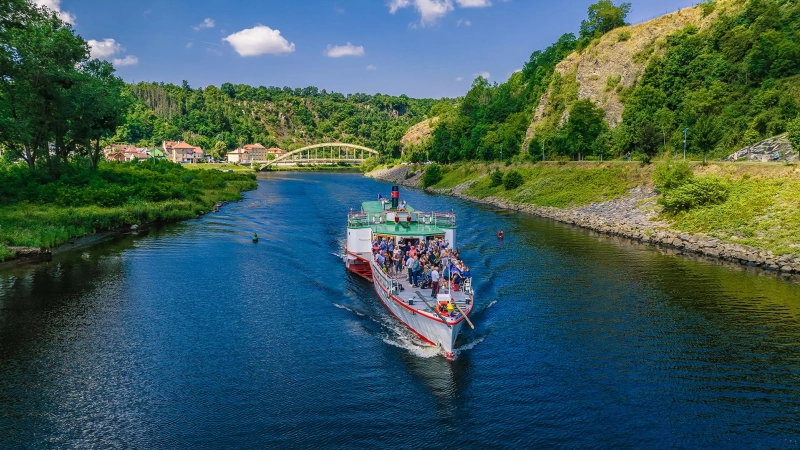
In 1948 PPS was nationalised as a part of ČPSL. The fleet, extensive again, allowed to introduce heavy traffic between Prague and Štěchovice and to operate other routes to the Veltrusy Chateau, Mělník, between Ústí and Hřensko and between Poděbrady and Kolín. At the beginning of the 50s, two-days trips between Prague and Hřensko were organized as well. Another boom in the history of PPS was recorded between 1955 and 1960. The boom, however, ended up quickly with the lifestyle change in the 60s accompanied by the decreasing number of vessels due to scrapping. In 1961, passenger ship transport in Czechoslovakia was transferred to municipal enterprises. In Prague the passenger ship transport was transferred to Dopravní podnik hlavního města Prahy (“City of Prague Transport Company”). In the 60s, the fleet was upgraded again buying cruisers from Brno, Hungary and Poland. In the 80s, cruisers were bought from Germany too. Due to problems related to maintenance of steam engines and boilers, other paddle wheel steamboats were scrapped. After 1970, only four such steamboats remained in use.
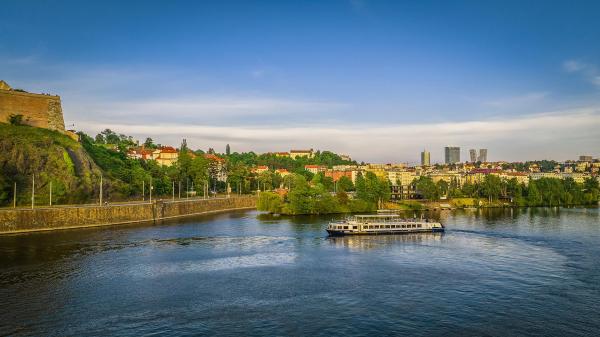
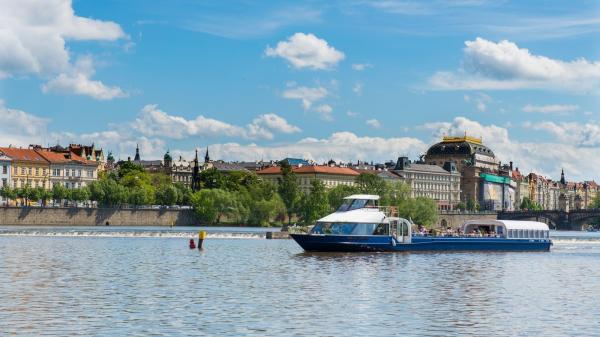
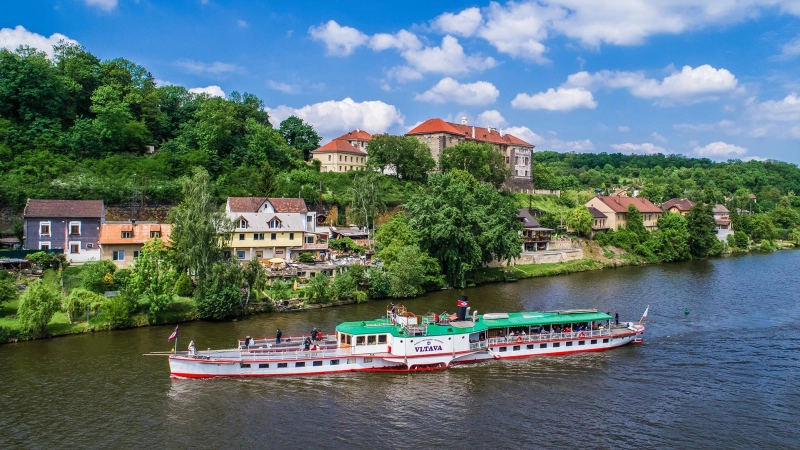
The changes in society after the end of communist era in 1989 showed themselves in PPS one year later. The company became independent and it had to adapt itself to the market competition. It’s former monopoly was replaced by an intense competition of a number of newly established companies. The most important was the Evropská vodní doprava s.r.o. (“European Water Transport”, EVD, established in 1991), owned by Mr Richard Vojta. At present, PPS is lead by the director Mr Dušan Sahula and forms a part of the EVD Group. The fleet includes two operable paddle wheel steamboats and four cruisers. Another paddle wheel steamboat shall be repaired in the Chvaletice shipyard. The area of operation includes the centre of Prague and the traditional routes of PPS from Prague to the Slapy dam and from Prague to Mělník.
3. The fleet. The book describes the development of the fleet from 1865. Detailed descriptions including ten technical sheets are available, the individual ships are described by the types of vessels. The first type covers large paddle wheel steamboats that can be divided into four groups: steamboats constructed by the Ruston’s factory in Prague, former Saxon steamboats of SBDG operated later in Bohemia and the four modern steamboats constructed within the frames of the renewal of ČPSL’s fleet from 1938 to 1945. Another chapter describes smaller paddle wheel steamboats that were not typical members of the PPS’s fleet. Two other chapters describe individual types of propeller vessels (and one “turbine steamboat”, fountain-propelled steamboat PŘEMYSL). A separate chapter is dedicated to steam engines, particularly to the oscillating, horizontal and vertical steam engines, as well as to boilers and diesel engines.
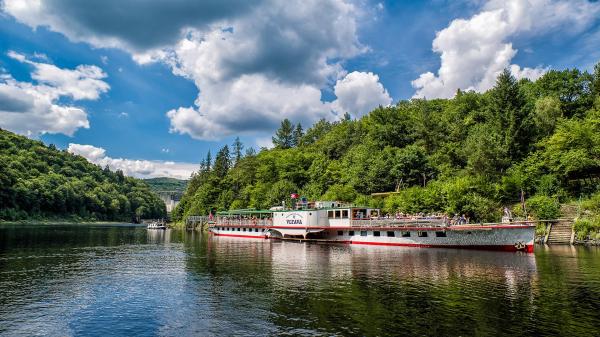
4. Aboard Prague steamboats. This chapter describes the two traditional Vltava routes of PPS. The route from Prague to the Slapy dam penetrates a beautiful hilly landscape, ending in the rocky canyon of the former Svatojánské proudy. However, the passengers on the 54 km long route downstream to Mělník are presented mainly cultural and technical monuments. This chapter includes also a non-technical description of the channel regulation works and the navigation technology.
The book concludes that it is desirable that the Prague steam navigation, now more than hundred years old, with its valuable historical steamboats and modern comfortable cruisers, should be developing further so that it can show from the unusual perspective from water level the beauty of Prague and its surroundings to the foreign and domestic visitors for many more years.